


Advanced Laser Control for Flexible Pulsing Patterns
Pulsing Unit: Flexible pulsing patterns
The FIFO buffer is an often overlooked feature of the Pulsing Unit. It allows the Pulsing Unit to generate flexible pulsing patterns which expand the scope of application of the Pulsing Unit significantly. In this short article, we want to give some insight into the Pulsing Unit FIFO buffer.
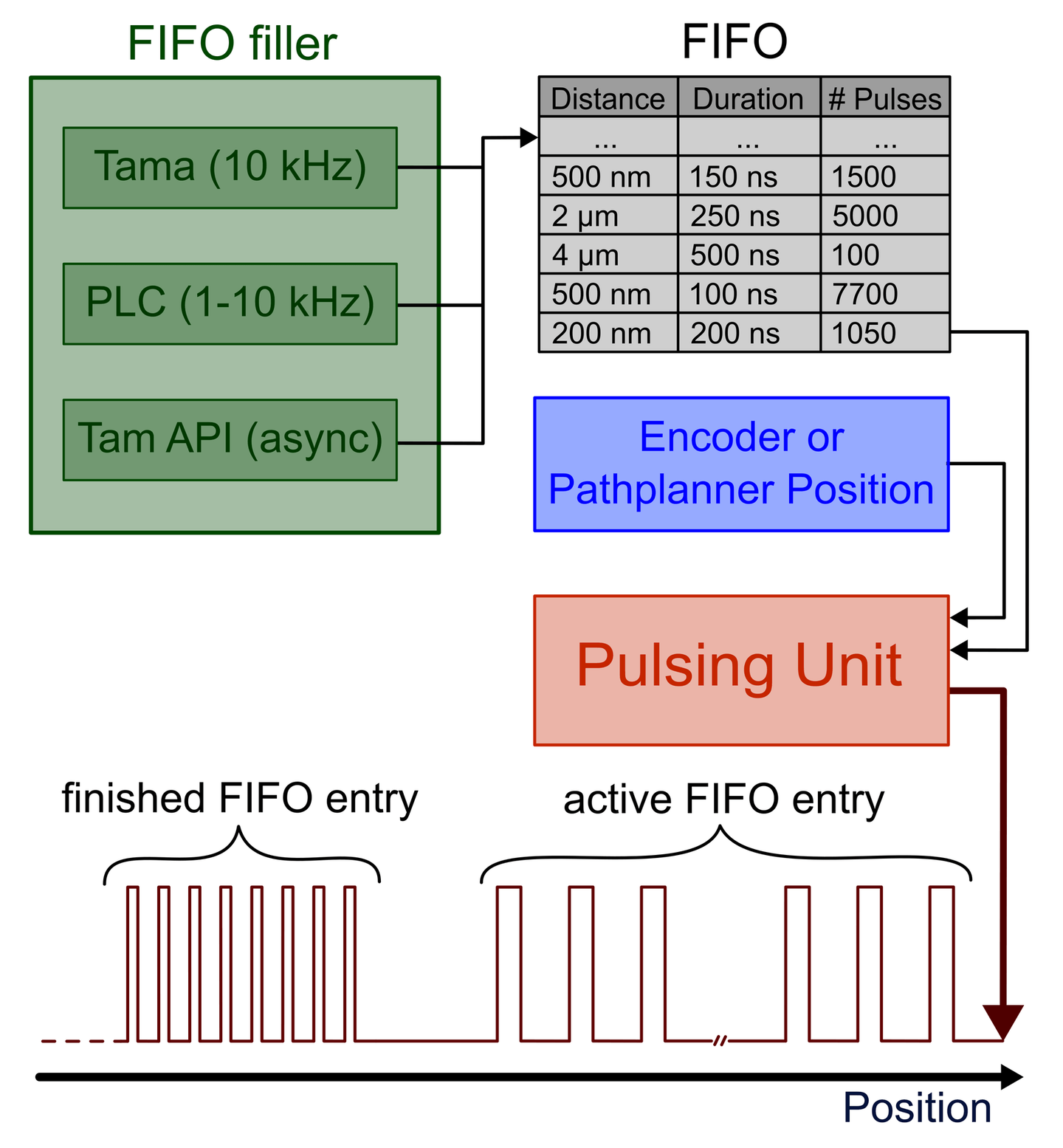
In its 'Direct' mode, the Pulsing Unit can be reprogrammed once per 10 kHz firmware cycle. While this already provides much flexibility and suffices for many applications, it is still far below the maximum pulsing frequency of 10 MHz. Hence, at maximum pulsing frequency, groups of 1000 pulses would have the same distance and duration. With the FIFO mode, the Pulsing Unit overcomes this 10 kHz limitation by allowing pulse sequences to be defined down to the level of individual pulses, each with its own distance and duration. If all pulses of an active sequence have been generated, the next sequence in the FIFO buffer is automatically activated and pulsing continues seamlessly.
The FIFO can take up to 512 individual sequences and can be refilled while being used by the pulsing unit, one sequence per 10 kHz firmware cycle. Since the refilling is tied to the firmware cycle time, real-time Tama programs constitute an efficient method to fill the Pulsing-Unit FIFO buffer. The required parameters for the sequences can be calculated directly in the Tama, e.g. if a series of sequences is used repeatedly. If the sequences are more random, or tailored to individual processes, they can also be written to a TAM table and loaded to the drive, where the Tama program simply takes the information and feeds it to the FIFO buffer. With a single large TAM table, over 600'000 pulsing sequences can be configured.
In summary, the FIFO mode extends the flexibility of the Pulsing Unit far beyond repetitive pulsing and allows for complex pulsing patterns in your pulsing applications. Contact us at support@triamec.com to discuss your planned application and how to make the most out of the Pulsing Unit.
More information can be found in Application Note "AN152 Pulsing Unit".