


System Integration Overview
Triamec servo drives can be integrated into PLC-based control systems, or used directly as motion platform in PC-controlled machines.
EtherCAT and Tria-Link provide deterministic real-time fieldbus communication and precise synchronization between drives. Ethernet is used to connect servo drives to PC applications for point-to-point motion commands and Trajectory Streaming.
|
EtherCAT |
Deterministic cyclic communication with the EtherCAT Master for PLC/CNC machines and mixed-vendor systems |
|---|---|
|
Tria-Link |
Deterministic drive-to-drive communication for distributed, high-performance systems based on Triamec drives; TAM API and Trajectory Streaming via PCIe TL adapter |
|
Ethernet |
TAM API and Trajectory Streaming for PC-controlled machines; service access for commissioning and diagnostics |
|
USB |
Local service access for commissioning and diagnostics |
EtherCAT Integration
- Compatible with standard EtherCAT systems
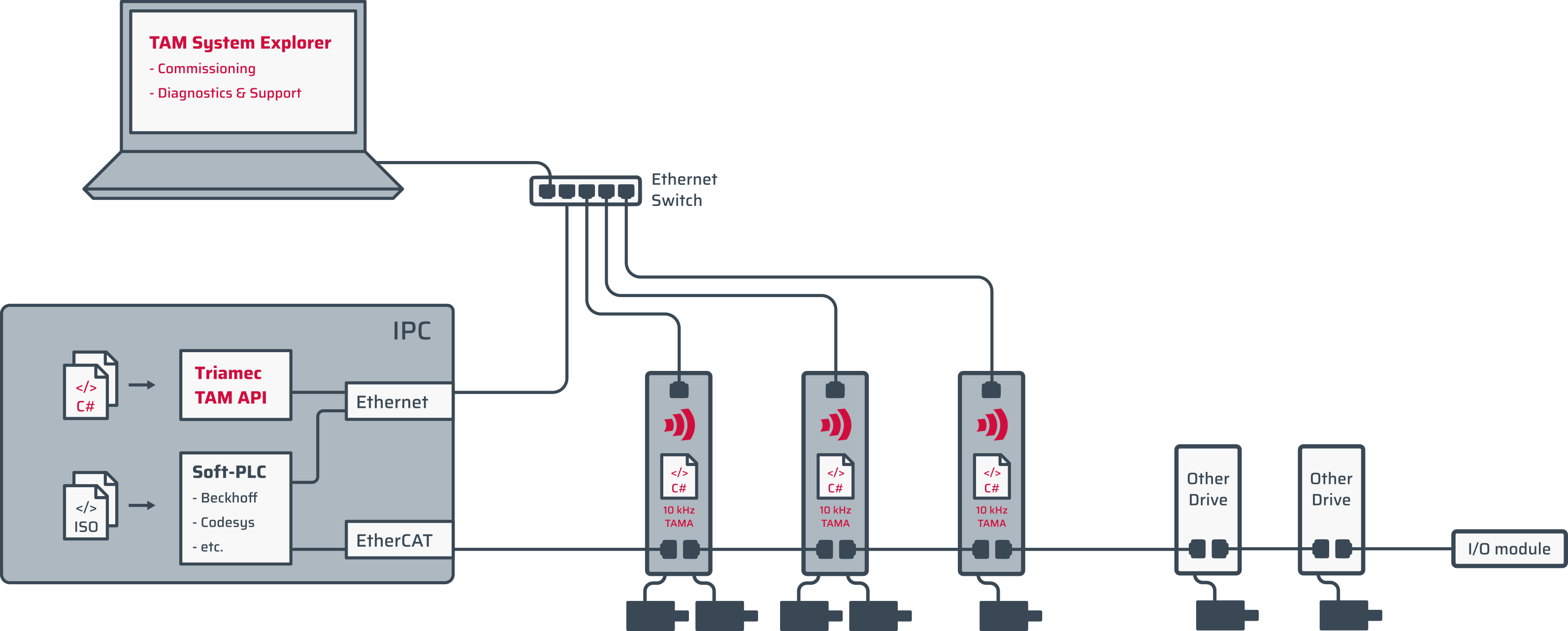
EtherCAT is the preferred choice when Triamec drives are integrated with third-party systems, I/O devices and other automation components under a common PLC or CNC controller (e.g. TwinCAT, Codesys).
Triamec servo drives support the following EtherCAT cycle times:
Standard CoE communication is used to access drive parameters and process data. For Beckhoff TwinCAT systems, Triamec provides ESI files, libraries, application examples and setup documentation for PLC, NC and CNC applications.
Tria-Link Integration
- 10 kHz real-time fieldbus
- Direct drive-to-drive communication
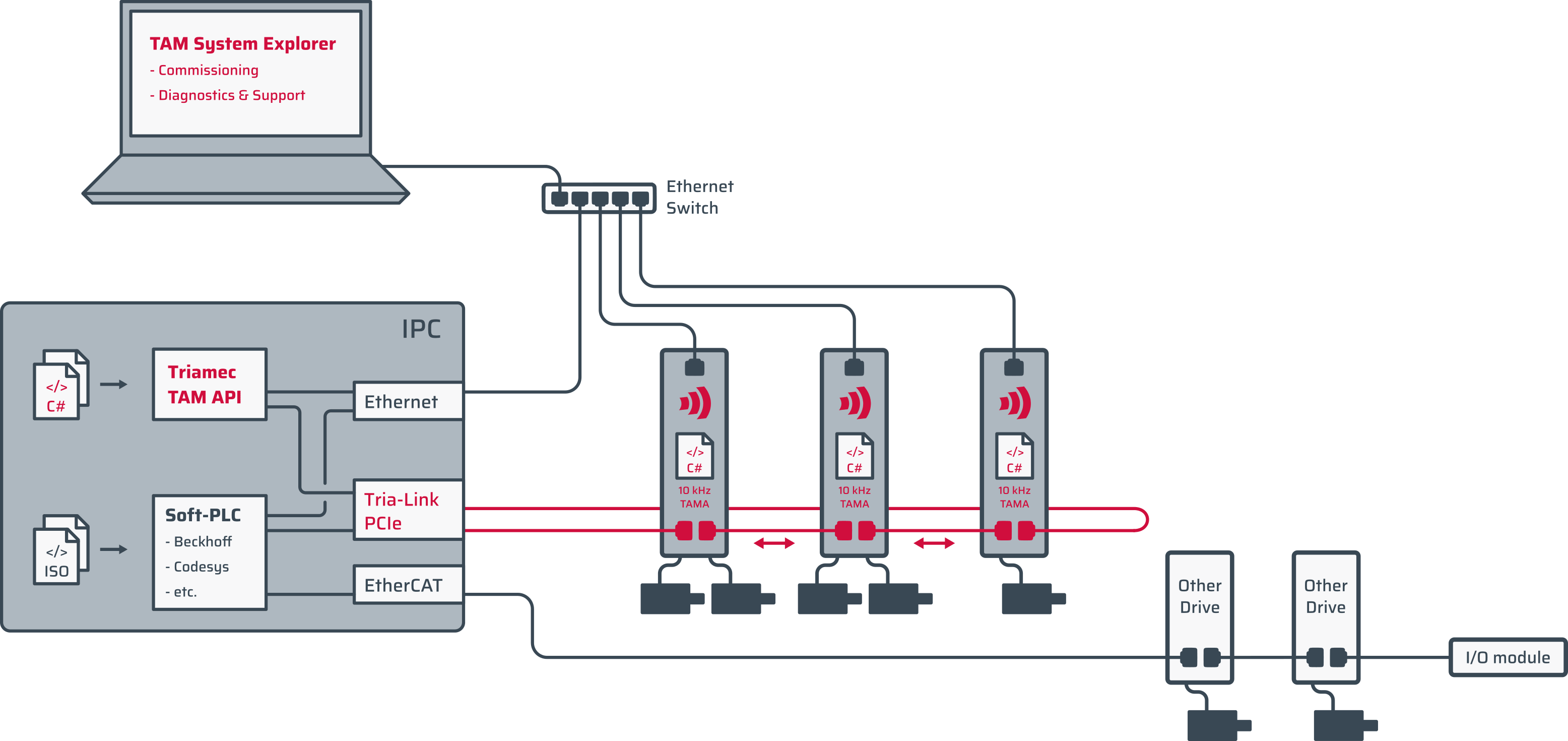
Tria-Link is Triamec’s real-time fieldbus for tightly synchronized multi-axis systems. The fieldbus is based on a 10 kHz rate and synchronizes clocks with sub-100 ns precision. A Tria-Link PCIe Adapter TL is necessary for an integration with PLC / CNC machines (e.g. with TwinCAT or Codesys).
The counter-rotating double-ring topology provides a total transmission rate of 200 Mbps and allows drives to exchange cyclic data directly, without routing through a central controller. This enables a direct exchange of cross-axis information for advanced control strategies.
EtherCAT or Tria-Link
|
|
EtherCAT |
Tria-Link |
|---|---|---|
|
Typical use |
PLC/CNC and mixed-vendor machines |
Systems that require advanced multi-axis coordination |
| Communication | Cyclic communication coordinated by the EtherCAT master | Direct drive-to-drive communication |
|
Supported cycle |
Selectable from 2 ms to 100 µs |
Fixed 100 µs cyclic communication |
|
Integration |
Standard CoE client |
Triamec library |
Trajectory Streaming
- Up to 50 kHz target data
- Drive-side buffering
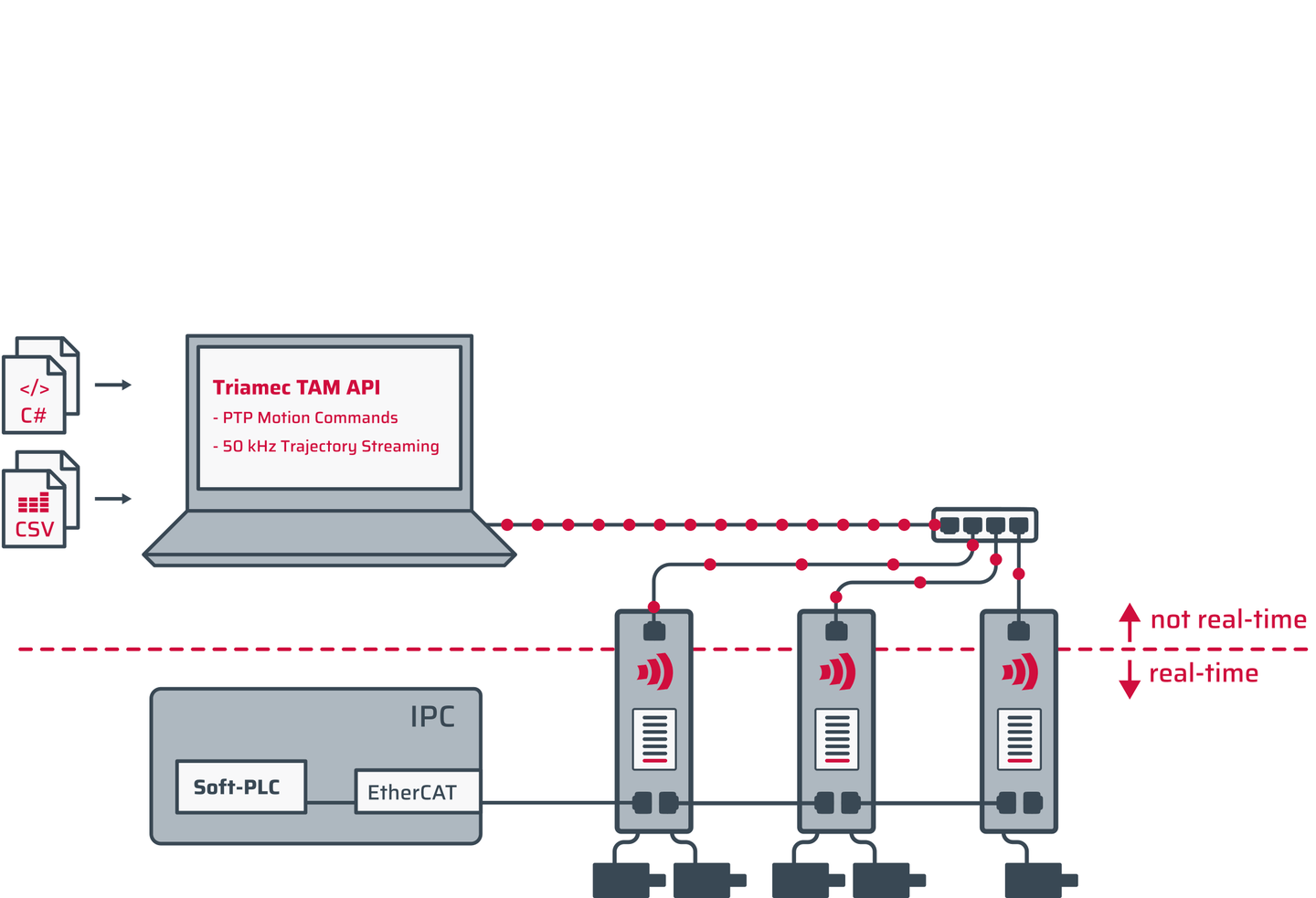
With Trajectory Streaming (TraSt), high-density multi-axis path data can be sent directly to the servo drives without any additional high-level controller. The position data is streamed through a standard Ethernet connection and buffered on the servo drives. The drives execute the trajectory at sampling rates of up to 50 kHz.
By separating trajectory generation from real-time execution, paths can be calculated offline, which reduces requirements on the host system. Ultra high sampling rates effectively eliminate interpolation errors and line-to-line artefacts. Axis synchronization is provided by EtherCAT or Tria-Link.
TraSt EtherCAT Integration
- Trajectory Streaming within existing PLC and CNC systems
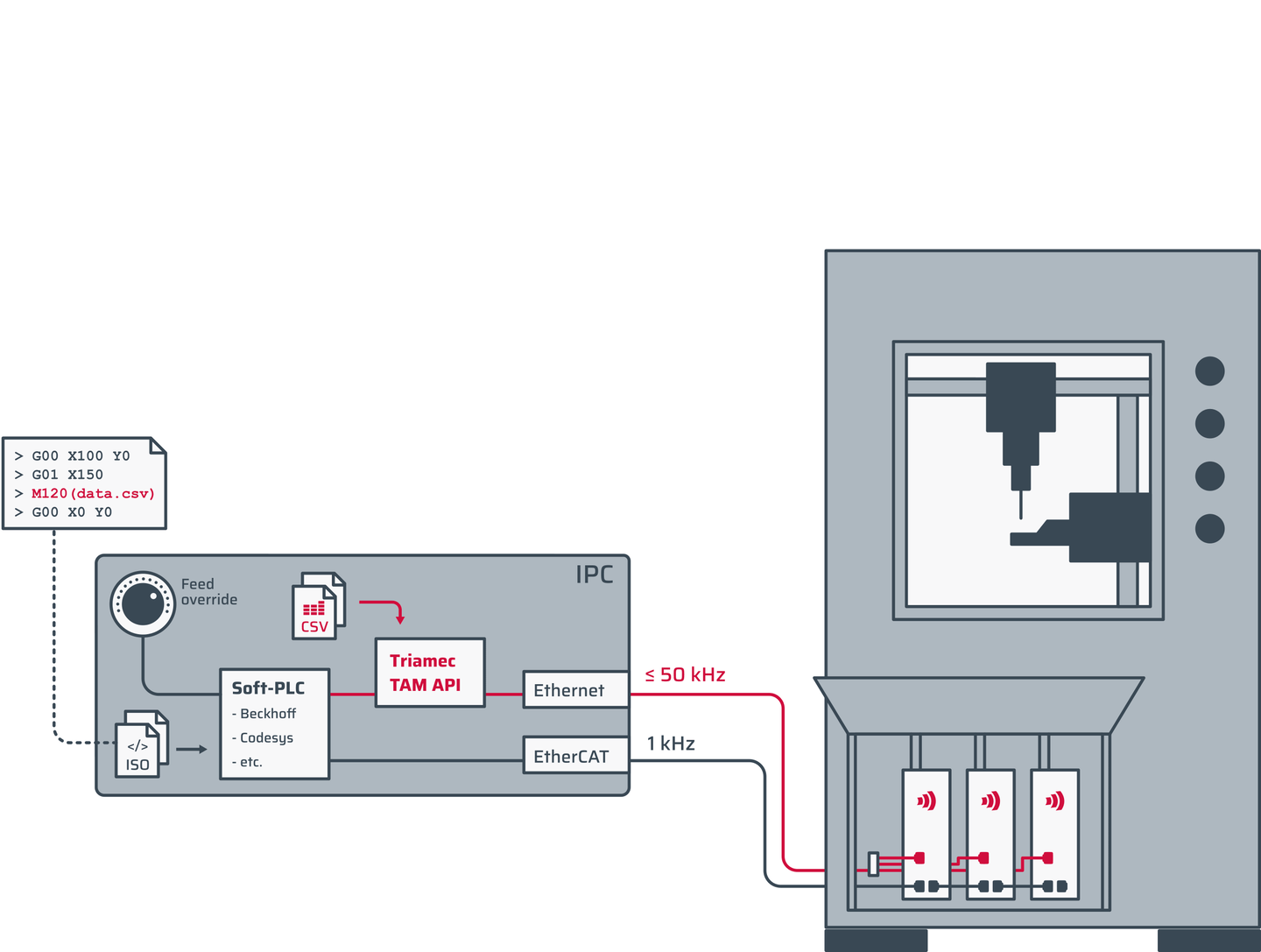
The TraSt EtherCAT Integration adds Trajectory Streaming to existing PLC architectures. The PLC remains the master and handles the process sequence, interlocks, safety logic and standard positioning.
For precision-critical process steps, a precomputed trajectory file is used as a dedicated motion block and streamed via Ethernet. The PLC supervises the streaming mode, can abort the motion at any time and returns seamlessly to standard positioning after completion.
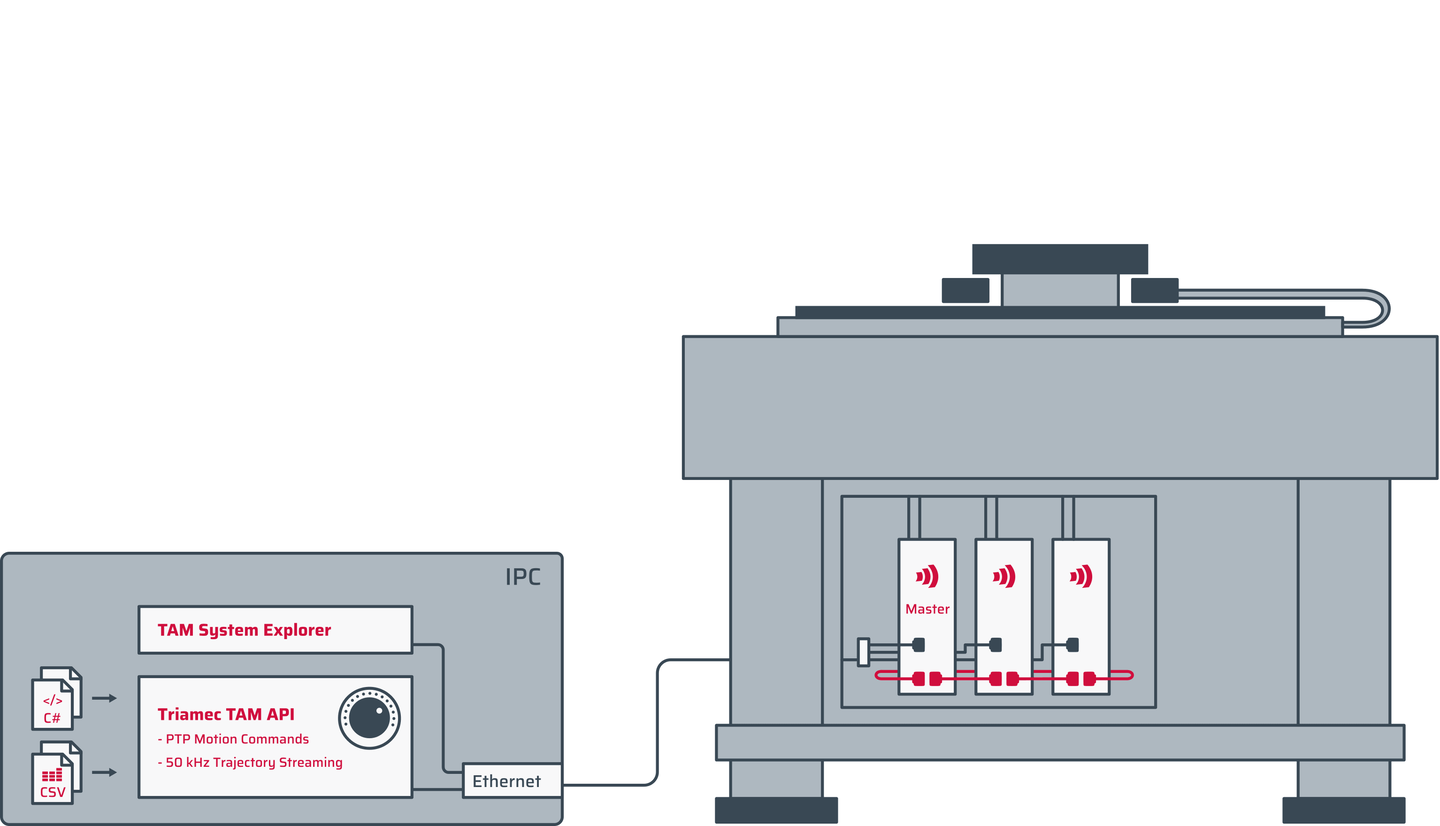
Tria-Link Master Mode
- Drive-level Tria-Link synchronization
A Tria-Link system does not necessarily require a TL PCIe adapter. Instead, one servo drive can be configured as the Tria-Link Master. This drive coordinates the synchronization within the network.
Combined with the TAM API and an Ethernet-connected PC, this architecture provides a flexible and cost-effective solution for machines that do not require a conventional real-time PLC or CNC controller. Point-to-point (PTP) motion commands can be issued directly via the TAM API, while TraSt provides full flexibility for multi-axis trajectories.
Typical applications include:
- Wafer and inspection stages
- Laboratory and measurement equipment
- Specialized production machines